Getting your Commercial Registration in Saudi Arabia feels like a significant milestone — and it is. But founders who’ve been through the process will tell you that the CR is really just the starting line. What comes after is where most startups quietly struggle.
The real operational challenge isn’t registration. It’s what happens next: connecting your finance system to ZATCA’s e-invoicing platform, running payroll in a way that syncs correctly with GOSI, tracking Saudization ratios across a growing headcount, managing visa renewals through Muqeem, and making sure every expense approval leaves a clean audit trail. Do any one of these manually, in isolation, and you’re building toward a compliance problem that will surface at the worst possible time — during a funding round, a ZATCA audit, or a Ministry of Commerce inspection.
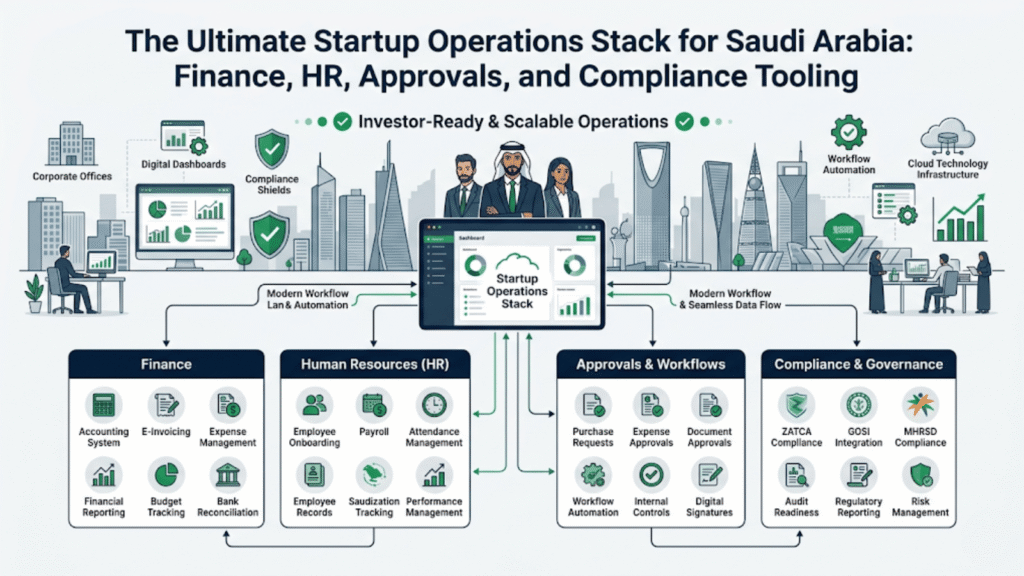
The solution isn’t more spreadsheets. It’s a properly designed operations stack — a connected set of tools and government portal integrations that runs the compliance function in the background while you focus on building the business.
This guide breaks down exactly what that stack looks like, what goes wrong when it’s missing, and how to build it correctly from day one.
About This Guide: This operations blueprint was developed by Syneffo Solutions‘ business automation team, drawing on direct experience designing workflow systems and compliance integrations for startups and scaling businesses across Saudi Arabia, UAE, and Malaysia.
What Is a Startup Operations Stack in Saudi Arabia?
A startup operations stack in Saudi Arabia is an integrated system of software tools and government portals used to manage finance, HR, approvals, and compliance. An effective stack automates payroll, tracks digital approvals, ensures ZATCA e-invoicing compliance, and syncs internal master data with mandatory platforms including GOSI, Qiwa, and the Ministry of Commerce — creating a single, auditable operational infrastructure rather than a fragmented collection of manual processes.
The Most Important Distinction: Internal Tools vs. Government Portals
Before building your stack, you need to understand something that trips up almost every founder entering the Saudi market: buying a global software platform does not fully cover your operational needs in KSA.
Your operations stack in Saudi Arabia has two distinct layers, and both matter.
Your internal tools are the software you choose, configure, and control — your accounting system, your HRIS, your document management platform, your approval workflows. These exist inside your organization.
Government portals are the platforms you must update — ZATCA for tax and e-invoicing, GOSI for social insurance, Qiwa and Muqeem under MHRSD for labor and visa management, the Saudi Business Center for entity filings. These exist outside your organization but are directly connected to your legal obligations.
The gap between these two layers is where most operational problems happen. A payroll system that calculates salaries correctly but doesn’t sync with GOSI creates a social insurance mismatch. An accounting system that generates invoices without ZATCA Phase 2 integration creates a tax compliance failure. An HR platform that manages employee records but doesn’t connect to Muqeem creates visa renewal delays.
The goal of a well-designed operations stack is to close that gap — so that what happens inside your systems automatically reflects what the government portals need to see, without manual re-entry at every step.
Building the Operations Stack: Step by Step
Step 1: The Finance and Accounting Layer
This is the foundation everything else depends on. Your finance system must work correctly for the Saudi regulatory environment — which means it has to be ZATCA-compliant before anything else.
Under ZATCA’s Phase 2 Fatoora e-invoicing mandate, every B2B invoice must carry a cryptographic stamp and be transmitted to ZATCA’s platform in real time. An invoice that doesn’t meet this standard isn’t just non-compliant — it may not be accepted by your corporate clients, many of whom are themselves under audit and cannot process non-compliant invoices.
The practical requirement: your accounting software needs native ZATCA Phase 2 integration built in, not bolted on. Custom API workarounds are technically possible but create brittleness that shows up as failures at the worst moments.
Beyond e-invoicing, your finance layer needs to automate the monthly close process. Every month, by the 5th business day, your trial balance should reconcile against corporate bank statements and the ledger should lock. This creates the clean, consistent audit trail that SOCPA-standard statutory audits require and that institutional investors expect when they request management accounts.
Expense management also belongs here. Every purchase — from a SAR 50 software subscription to a SAR 50,000 vendor payment — should have a digital receipt or invoice attached to the transaction line. No voucher, no payment. This is the internal controls standard that makes ZATCA audits straightforward rather than stressful.
Step 2: The HR and Payroll Automation Layer
HR operations in Saudi Arabia are more complex than most markets, and manual management creates risks across multiple fronts simultaneously.
Your HR system needs to handle employee onboarding with the specific documentation requirements of the Saudi market — Iqamas for expatriate employees, passport copies, contract authentication through Qiwa, and GOSI registration that must happen before the employee’s first payroll run. Miss the GOSI registration step, and the first payroll creates a mismatch that takes time and effort to unwind.
Payroll calculation in Saudi Arabia has local-specific components. End-of-service benefit (ESB) calculations follow a specific formula under Saudi labor law. GOSI contributions have both employer and employee components with defined percentages. Salary payments must be processed through the Wages Protection System (WPS) — a mandatory payroll processing requirement tied to your GOSI compliance and Nitaqat rating. An HR platform that doesn’t handle these natively requires manual overrides that introduce errors over time.
The sequencing matters: GOSI registration must be active before the first payroll run. The Qiwa work contract must be authenticated before the employee’s Iqama can be issued. Muqeem must be updated when employees arrive or depart. These aren’t independent steps — they’re a chain, and breaking any link creates downstream problems.
Your HRIS should also track Saudization ratios by department and in aggregate. Knowing your Nitaqat classification in real time — rather than discovering a Yellow or Red status during a renewal — gives you the lead time to hire ahead of a quota problem.
Step 3: The Approvals and Workflow Layer
Most early-stage startups run approvals through email. Someone requests a vendor payment, sends it to the CEO, the CEO responds from their phone, and finance processes it based on a WhatsApp message. This is not an audit trail. It’s a liability.
A digital approval workflow replaces this with something that holds up under scrutiny. Every expense request routes through a defined workflow based on the amount and category. A SAR 2,000 software subscription might auto-approve under a pre-set category budget. A SAR 30,000 vendor payment requires finance manager and COO sign-off. A new hire request triggers a workflow that includes budget confirmation, HR documentation, and a GOSI pre-check.
The value here isn’t just efficiency — it’s documentation. When a ZATCA auditor or an investor’s due diligence team asks “what was the approval process for this payment?”, the answer is a timestamped digital audit trail with named approvers, not a search through email threads.
Role-based access control is also part of this layer. Define which team members have access to which systems and portals. Access to the Saudi Business Center, ZATCA, and GOSI portals should be restricted to authorized personnel — not left as a shared login used by whoever happens to need it that day.
Step 4: The Document Management and Audit Layer
By the time you’ve been operating for 12 months, your company has generated a significant volume of legally important documents: board resolutions, shareholder agreements, audited financial statements, Ministry of Commerce filings, commercial lease agreements, vendor contracts, employee files, and visa documentation. If these live in a mix of email inboxes, physical folders, and individual hard drives, you have a retrieval problem that becomes a crisis the moment you need anything urgently.
A centralized document management system gives every document a defined home, a defined owner, a retention period, and — critically — a renewal or expiry date trigger. Your CR has an expiry date. Your MISA license has a renewal cycle. Every Iqama in your employee file has an expiry date. Your Ejar commercial lease has a renewal date. Miss any of these and you face both a compliance problem and an operational disruption.
The document layer also makes investor readiness practical. When a VC requests a data room, your answer should be a shared link — not two weeks of preparation. A well-organized document repository means due diligence is a review exercise, not a recovery operation.
Common Mistakes That Break Startup Operations
The spreadsheet trap. Managing employee master data, payroll deductions, and leave balances in Excel is a risk that compounds over time. A formula error in a salary calculation creates a GOSI mismatch. A missing row in the leave tracker creates a payroll overpayment. These errors are hard to catch and expensive to unwind, especially when they’ve been running for several months before anyone notices.
Buying global tools without checking local gaps. A globally recognized HR platform or accounting system is not automatically suitable for Saudi operations. Before committing to any tool, map out Saudi-specific requirements: Arabic invoice generation, ZATCA API integration, WPS-compliant payroll output, Nitaqat ratio tracking, end-of-service benefit calculations. If the tool doesn’t cover these natively, you’re building workarounds before you’ve started.
Treating the GRO as a separate function. Many startups hire a Government Relations Officer and then treat their portal update work as completely separate from HR and finance workflows. The result is a permanent re-entry problem — data from the HRIS gets manually re-entered into Muqeem, payroll data gets manually re-entered into GOSI. Every manual re-entry is an opportunity for a mismatch. The GRO function should be integrated into the operational workflow, not isolated from it.
Approval bottlenecks at the top. When every expense approval routes to the CEO, you create a single point of failure and signal that the organization doesn’t trust its own managers. Define tiered spending limits, automate routine approvals, and reserve executive approval for genuinely significant decisions.
Delay Factors and Compliance Problems to Watch For
Missed entity renewals. The CR, MISA license, National Address certificate, and Chamber of Commerce membership all have expiry dates. Without a centralized system tracking these with advance alerts, renewals get missed. A lapsed CR doesn’t just attract a fine — it can suspend your ability to issue invoices, access government portals, and maintain active employee visas.
ZATCA e-invoicing clearance failures. If your billing software lacks proper ZATCA Phase 2 API integration, invoices may transmit with incorrect data or fail clearance entirely. A rejected clearance means the invoice isn’t legally recognized — which creates a problem for both your tax records and your client’s.
Delayed new hire onboarding. When HR onboarding tasks aren’t sequenced with MHRSD and Muqeem portal updates, new employees wait. The visa sponsorship process, Iqama issuance, and GOSI registration all need to happen in a specific order. A new hire who can’t start for six weeks because of documentation sequencing errors is both an operational problem and an employer brand problem.
Practical Solutions for Workflow Automation
Build a unified compliance calendar. Map every recurring obligation across ZATCA, MOC, MHRSD, GOSI, and MISA. VAT filing cycles, corporate income tax deadlines, quarterly investment reports, Iqama renewal dates, CR and license expiry dates, Nitaqat reporting windows — every one of these goes into a centralized digital calendar with automated alerts at 90 days, 30 days, and 7 days before the deadline. Assign a named owner to each item.
Implement role-based access control across all systems. Define who can update internal master data. Define who has portal access to ZATCA, GOSI, Qiwa, and the Saudi Business Center. Define who can approve payments at each tier. Write this down, implement it in your systems, and review it every time someone joins or leaves the team.
Know what to outsource. Some compliance functions — particularly portal management and government relations — are more efficiently handled by a specialized partner than by an internal hire in the early stages. A fractional CFO who understands the cross-border compliance interactions between MISA and ZATCA provides specific value that a general-purpose finance hire might not. An outsourced PRO/GRO service that handles Muqeem, Qiwa, and Ministry of Commerce interactions removes a category of operational risk while you’re still building scale.
KSA Operations Compliance Landscape
| Entity / Portal | What Your Stack Must Manage |
| ZATCA (Fatoora) (zatca.gov.sa) | E-invoicing data transmission, VAT return generation, corporate income tax tracking, audit trail integrity |
| GOSI (gosi.gov.sa) | Monthly payroll syncing, social insurance deductions, WPS salary processing, employee record updates |
| MHRSD / Qiwa / Muqeem | Saudization (Nitaqat) ratio tracking, work permit renewals, contract authentication, Iqama management |
| Ministry of Commerce (Qawaem) (mc.gov.sa) | Annual audited financial statement uploads, CR updates, and activity amendments |
| MISA (misa.gov.sa) | Quarterly investment reports for foreign-owned entities, investment license renewals |
| Saudi Business Center (business.sa) | Entity management, cross-government portal integration, pre-filing validation |
The Operations Stack Checklist
Run through this before you process your first invoice or onboard your first employee.
- [ ] Finance: Is the accounting software natively integrated with ZATCA Phase 2 Fatoora — tested, not just configured?
- [ ] Payroll: Does the HR system accurately calculate end-of-service benefits, GOSI contributions, and WPS-compliant salary outputs?
- [ ] Approvals: Is there a documented, digital audit trail for all expense approvals and vendor payments, with named approvers and timestamps?
- [ ] Portal access: Are access rights to Muqeem, Qiwa, ZATCA, and GOSI restricted to specifically authorized personnel, with no shared logins?
- [ ] Compliance calendar: Are all entity renewal dates, VAT filing cycles, and statutory deadlines loaded into a centralized alert system with named owners?
- [ ] Document repository: Does every critical document — CR, MISA license, Iqamas, contracts, board resolutions — have a defined home with an expiry date trigger?
- [ ] Nitaqat tracking: Is your Saudization ratio visible in real time, updated automatically as headcount changes?
Frequently Asked Questions
Common questions from founders and operations leaders building a compliant, automated business stack in Saudi Arabia.
-
At minimum, Saudi startups need three core tools: a ZATCA-compliant accounting system with native Phase 2 Fatoora e-invoicing integration, an HR platform capable of local payroll calculations including end-of-service benefits, GOSI contributions, and WPS-compliant salary outputs, and a secure document management system for compliance tracking with expiry date alerts. Most startups succeed with a tightly integrated “best-of-breed” stack where each tool natively handles Saudi-specific requirements, rather than relying on a single global ERP that may require significant local customization.
-
By treating portal updates as formal operational steps — not ad hoc tasks — integrated directly into the HR and finance workflows rather than handled separately. This means assigning named owners to each portal (ZATCA, GOSI, Qiwa, Muqeem, Saudi Business Center), restricting access to authorized personnel only, and sequencing portal updates into the standard onboarding, payroll, and filing workflows. Many startups use a dedicated GRO (Government Relations Officer) or an outsourced compliance partner whose work is scheduled and tracked through the same operational calendar as finance and HR tasks.
-
The three highest-priority automation targets are payroll calculations (eliminating manual ESB and GOSI contribution errors), e-invoicing generation (ensuring every invoice meets ZATCA Phase 2 Fatoora compliance automatically), and internal expense approvals (replacing email-based approvals with a documented, role-based digital workflow). These three areas yield the highest immediate return in terms of both operational efficiency and compliance risk reduction — and they’re also the areas that most commonly cause problems during ZATCA audits and investor due diligence.
-
Start by mapping every recurring obligation across ZATCA (VAT filing cycles, corporate income tax deadlines), MOC (CR renewal, Qawaem annual filing), MHRSD (Nitaqat reporting), GOSI (monthly payroll cycles), and MISA (quarterly investment reports for foreign-owned entities). Add all employee Iqama expiry dates and entity license renewal dates. Enter every item into a centralized task management or calendar tool with automated alerts at 90, 30, and 7 days before each deadline, and assign a named owner to each obligation. Review and update the calendar whenever regulations change or new staff join.
-
While some robust ERPs cover multiple bases, most Saudi startups succeed with a tightly integrated “best-of-breed” stack — where each tool natively handles its specific local requirements rather than relying on one platform to do everything. The critical principle is integration: your accounting system, HRIS, and document management platform need to share data cleanly, ideally through native API connections rather than manual exports. Before choosing any platform, validate that it meets Saudi-specific requirements — ZATCA Phase 2 compliance, WPS-compatible payroll output, Arabic invoice generation, and Nitaqat tracking — rather than assuming a global platform automatically handles local needs.
Conclusion: Systems That Run the Business for You
A startup operations stack in Saudi Arabia isn’t a luxury you add later — it’s the infrastructure that makes everything else possible. It’s the bridge between your internal ambitions and the strict compliance reality of operating in the Kingdom.
When finance, HR, and compliance talk to each other — when your payroll system syncs with GOSI, your invoicing platform integrates with ZATCA, and your compliance calendar alerts the right person 90 days before every deadline — you stop managing administration and start managing growth.
The founders who scale successfully in Saudi Arabia aren’t the ones who work hardest on compliance. They’re the ones who build systems that handle compliance correctly in the background, so they can focus on product, customers, and capital.
Build the stack right from day one. The cost of doing it correctly is a fraction of the cost of unwinding a fragmented operation during a funding round or an audit.
Struggling to connect your software to Saudi compliance realities? Syneffo Solutions designs, automates, and implements robust business operations stacks tailored for startups and scaling businesses in Saudi Arabia. We map your internal tools to government portal requirements, automate your compliance calendar, and make sure your operational infrastructure is ready for growth — and for scrutiny.
Contact Syneffo Solutions to Design Your Operations Stack
About the Author Written by the Syneffo Solutions Business Automation Team — specialists in workflow design, compliance tooling, and digital transformation for scaling businesses across Saudi Arabia, UAE (Sharjah), and Malaysia (Selangor). Syneffo has 25+ years of combined executive experience. Contact us at info@syneffosolutions.com


