
Entering the Saudi market has become one of the biggest growth opportunities for international businesses. With the momentum of Vision 2030, foreign investment reforms, and increasing demand across sectors like technology, construction, healthcare, logistics, consulting, and retail, more founders are exploring expansion into the Kingdom than ever before.
But once the excitement begins, confusion usually follows.
Most foreign investors quickly encounter terms like “company setup,” “business consultant,” “PRO services,” “MISA licensing,” “Qiwa,” and “Commercial Registration.” On paper, many service providers seem to offer the same thing. In reality, they do not.
This confusion often leads to two expensive problems:
- Businesses overpay for overlapping services.
- Businesses underpay for incomplete setup packages that leave them operationally stuck.
It is common to see a company successfully obtain a Commercial Registration (CR) but then realize they still cannot hire staff, activate labor portals, process visas, or open a corporate bank account because critical post-incorporation steps were never completed.
Understanding the difference between company setup services, business consultants, and PRO services in Saudi Arabia is not just administrative knowledge. It directly affects your launch speed, compliance status, operational stability, and long-term scalability.
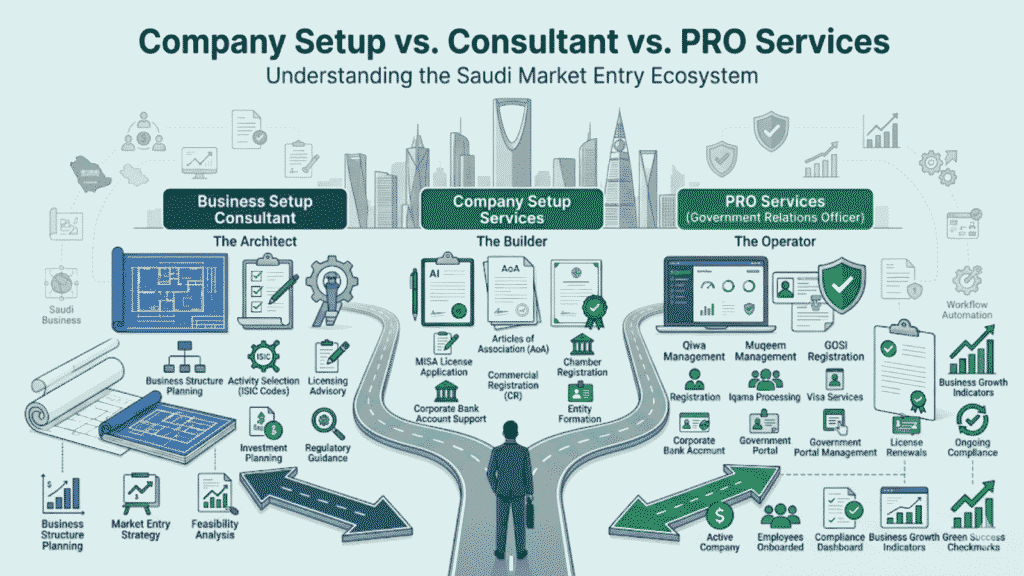
What Is the Difference Between Company Setup, Consultant Services, and PRO Services in Saudi Arabia?
The difference comes down to scope and responsibility.
- Business Setup Consultants focus on strategic planning, legal structuring, and regulatory guidance before the company is formed.
- Company Setup Services execute the actual legal incorporation and registration process.
- PRO Services handle ongoing government relations, labor systems, visa processing, renewals, and compliance management after the company becomes operational.
Think of it this way:
- Consultants design the roadmap.
- Setup providers build the legal entity.
- PRO teams keep the business operational every day.
Each service solves a different business problem.
Why This Distinction Matters in Saudi Arabia
Saudi Arabia has a highly interconnected government ecosystem.
Your company structure affects:
- Licensing approvals
- Banking eligibility
- Saudization requirements
- Visa allocations
- Tax classification
- Labor compliance
- Municipality approvals
- Commercial activity permissions
A small mistake early in the setup process can create delays that ripple across multiple ministries later.
For example, if a company selects the wrong ISIC activity classification during incorporation, it may later discover:
- It requires additional ministry approvals
- The capital requirement is significantly higher
- Certain activities cannot be performed legally
- Banking onboarding becomes difficult
- Work visa quotas become restricted
This is why experienced foreign investors rarely treat Saudi market entry as “just paperwork.”
Decoding the Service Pillars: What Each Actually Includes
1. Business Setup Consultants: The Strategic Architects
Business consultants operate at the planning level.
Their role is to evaluate your business model and determine the safest and most scalable way to establish your presence inside Saudi Arabia.
This becomes especially important for:
- Foreign-owned companies
- Multi-country operations
- Regulated industries
- Businesses requiring specialized licensing
- Companies planning long-term expansion
What Consultants Typically Handle
Strategic Entity Structuring
Consultants help determine whether your business should operate as:
- A 100% foreign-owned LLC
- A branch office
- A regional headquarters (RHQ)
- A joint venture
- A holding structure
The correct structure depends on taxation, ownership, operations, staffing plans, and sector regulations.
ISIC Activity Mapping
Saudi Arabia uses strict business activity classifications.
Consultants map your real-world services to approved ISIC activities to avoid future compliance problems.
For example:
A digital agency may assume it only needs a “marketing” activity. But if it also develops software products, hosts applications, or provides consulting, additional classifications may be required.
Capitalization & Feasibility Guidance
Some activities trigger minimum capital requirements or sector-specific restrictions.
Consultants help identify these risks before incorporation begins.
Regulatory Navigation
Certain sectors require approvals from secondary regulators beyond standard incorporation authorities.
Examples include:
- Healthcare
- Education
- Fintech
- Engineering
- Recruitment
- Food production
- Transportation
Consultants help businesses understand these approval pathways early.
2. Company Setup Services: The Legal Builders
Once the strategic structure is finalized, setup specialists execute the legal incorporation process.
Their role is operational and procedural.
What Company Setup Services Typically Include
MISA Investment License Application
Foreign investors usually require approval through the Ministry of Investment (MISA).
This process involves:
- Corporate document submission
- Legalized foreign documents
- Shareholder verification
- Activity approvals
- Licensing workflows
Drafting the Articles of Association (AoA)
The AoA defines:
- Ownership structure
- Share distribution
- Management authority
- Company governance
These documents are drafted in compliance with Saudi corporate law.
Commercial Registration (CR)
The CR is the company’s legal identity within Saudi Arabia.
Without a CR, the company cannot legally operate.
Initial Government Registrations
Depending on the provider, setup services may also include:
- Chamber of Commerce registration
- Municipality licensing
- National Address registration
- Tax authority registration with ZATCA
- Initial labor file activation
However, this is where many businesses get caught off guard.
Not every provider includes these operational steps.
Some providers stop immediately after issuing the CR.
3. PRO Services (Public Relations Officer / GRO): The Operational Operators
PRO services are often misunderstood.
Many foreign businesses assume PRO services are part of company setup. They are not.
A PRO (Government Relations Officer) handles ongoing interactions with Saudi government systems after the company becomes active.
These services are operational, recurring, and essential for day-to-day business continuity.
What PRO Services Typically Include
Labor & Immigration Portal Management
Saudi businesses operate through multiple mandatory government systems, including:
- Qiwa
- Muqeem
- GOSI
- Ministry of Commerce portals
- Municipality systems
A PRO manages these systems on behalf of the company.
Workforce Mobility
PRO teams handle:
- Block visa requests
- Work permit processing
- Iqama issuance and renewals
- Exit/re-entry visas
- Employee sponsorship transfers
Corporate Renewals
Saudi entities require continuous maintenance, including:
- CR renewals
- Chamber renewals
- Municipality license renewals
- Government file updates
- Corporate amendments
Document Processing
PRO teams also manage:
- Arabic document submissions
- Government appointment coordination
- Regulatory follow-ups
- Ministry communications
For foreign companies without local operational teams, this support becomes critical.
Side-by-Side Comparison: Consultant vs. Setup vs. PRO Services
| Service Type | Main Role | Timeframe | Focus Area |
| Business Setup Consultant | Strategic planning | Pre-incorporation | Structure, compliance, activity mapping |
| Company Setup Service | Legal incorporation | One-time project | Licensing and registration |
| PRO Service | Ongoing operations | Long-term recurring | Government relations and compliance |
Common Mistakes That Cost Businesses Time and Money
Hiring a PRO Too Early
A PRO cannot process visas or labor files for a company that does not yet legally exist.
Without:
- A CR
- Active portals
- Ministry registrations
there is very little a PRO can operationally execute.
The correct sequence matters.
Assuming Consultants Handle Physical Execution
Some international consulting firms provide excellent advisory reports but do not handle:
- Arabic translations
- MOFA attestation
- Government visits
- Portal activation
- Local coordination
Businesses discover this too late and end up scrambling for local support.
Falling for Cheap “CR-Only” Packages
Some low-cost providers advertise company formation at surprisingly low prices.
But the package may exclude:
- Chamber registration
- National Address activation
- Qiwa onboarding
- Tax registration
- Portal setup
- Banking support
The company technically exists but remains operationally incomplete.
Operational Friction: Hidden Boundaries That Trigger Delays
The Document Attestation Problem
Foreign corporate documents often require:
- Notarization
- Legalization in the country of origin
- Saudi Embassy attestation
- MOFA attestation inside Saudi Arabia
Many businesses incorrectly assume setup providers handle this automatically.
Not all do.
This becomes one of the most common causes of launch delays.
Portal Inactivity After Incorporation
Receiving a CR does not automatically activate operational systems.
Without proper onboarding into:
- Qiwa
- Muqeem
- GOSI
the company may be unable to:
- Hire employees
- Issue work permits
- Generate contracts
- Process visas
This gap frequently occurs when setup teams fail to transition the entity properly to ongoing PRO management.
Practical Business Examples
Example 1: The Lean Startup
A small foreign SaaS startup entering Saudi Arabia may only need:
- A consultant for ISIC validation
- A setup specialist for incorporation
- A fractional PRO provider for the first few employee visas
This keeps operational costs lean without sacrificing compliance.
Example 2: An Established International Company
A mid-sized overseas business opening a Saudi branch may require:
- Deep tax structuring advice
- Multi-entity planning
- Long-term PRO management
- Banking coordination
- Workforce scaling support
In this case, a fully integrated provider makes more sense.
Navigating the Saudi Government Ecosystem
Saudi business operations depend on multiple interconnected government platforms.
Understanding them helps founders better evaluate service providers.
MISA Portal
The Ministry of Investment gateway for foreign investors.
Used for:
- Investment licensing
- Foreign ownership approvals
- Investor records
Ministry of Commerce (MOC)
The authority responsible for:
- Commercial Registration issuance
- Corporate records
- Structural amendments
- Financial statement systems
Qiwa
The labor management platform under the Ministry of Human Resources.
Handles:
- Employment contracts
- Saudization tracking
- Work permits
- Workforce compliance
Muqeem
The immigration platform used for:
- Iqamas
- Visa processing
- Employee mobility
The Provider Evaluation Checklist
Before hiring any service provider in Saudi Arabia, ask these questions clearly.
Strategic Scope
- Does the provider validate ISIC business activities?
- Do they explain structural risks before incorporation?
Document Handling
- Are document legalization and MOFA attestation included?
- Who handles Arabic translation requirements?
Post-CR Operational Scope
- Does the package include Chamber registration?
- Is National Address setup included?
- Are labor portals activated?
Portal Onboarding
- Will the provider onboard Qiwa, Muqeem, and GOSI properly?
- Will ownership access credentials be transferred to your company?
Banking Support
- Do they assist with KYC preparation?
- Do they provide banking coordination support?
Pricing Transparency
- Are government fees separated clearly from service fees?
- Are recurring PRO charges disclosed upfront?
Clear answers prevent expensive misunderstandings later.
Conclusion: Clear Boundaries Create Faster Scaling
Saudi Arabia offers enormous opportunities for foreign businesses, but successful expansion depends heavily on operational clarity.
When businesses fail to distinguish between consulting, incorporation, and PRO responsibilities, they often face:
- Delays
- Duplicate costs
- Compliance gaps
- Workforce bottlenecks
- Banking complications
The smartest market entrants treat Saudi expansion as a structured operational process rather than a simple registration exercise.
By clearly defining who handles strategy, who executes setup, and who manages ongoing government operations, companies create a smoother path toward sustainable growth inside the Kingdom.
Your Automation and Growth Partner
This operational framework was developed by Syneffo Solutions, a Saudi-focused business automation and market entry partner helping international businesses reduce operational friction during expansion into the Kingdom.
From strategic entity structuring and company incorporation to long-term PRO operations and compliance workflows, Syneffo Solutions helps businesses build scalable foundations for growth in Saudi Arabia.
You can also explore their Saudi company registration resources or connect with their advisory team for a structured review of your market entry requirements.


